Daddy’s Grandfather Clock

Keeping Time
Written Winter 2008

One of my dad’s favorite songs to sing in the last years of his life was “Grandfather’s Clock” by Henry Work.  His signal to sing began with a beckoning to his grandchild to get the “yellow song book” from the piano bench. Then he took the child on his knee and with an earnest bass voice sang all 4 verses of the synchronous yet somewhat morbid ballad. Each grandchild especially loved the chorus:

But it stopped, short, never to go again, when the old man died.

Ninety years without slumbering, tick, tock, tick, tock,

His life seconds numbering, tick, tock, tick, tock,

It stopped, short, never to go again, when the old man died.

I never could figure out why he seemed so fascinated with this song since he had never sung it when I was growing up. Was it that the children loved the “tick, tock” or was it that one of his favorite earthly possessions was his grandfather’s clock that he built himself? It might have been both because between hearing Grandpop’s deep bass voice and hearing the clock chime just a few feet away, his grandchildren were usually spellbound.

When I was in high school Daddy built a grandfather’s clock from an Emperor Clock kit and he was never the same. He was proud of his accomplishment but there was something more, like he had a relationship with his clock. If the clock were losing time, Daddy could not rest until he resolved the problem. It was only in his later years that anyone besides Daddy fixed the clock. So, perhaps this song hit a familiar chord with Daddy and his clock. 

Now his grandfather’s clock chimes in our home, and Daddy would be pleased to know that it runs perfectly. It doesn’t seem to have the same omnipotent presence that it once had while residing at Halteman Road with my parents, but it always reminds me of my father. Sometimes I even apologize to Daddy when I’ve forgotten to wind it. Daddy had an intricate relationship with this clock, one that I can’t relate to, yet I always find the clock’s presence comforting and faithful. We all know “our hour of departure” will come, but as for now, let’s enjoy the precious moments God has given us. Happy New Year!  -BBM

For my uncle Paul

Paul Benner as deacon

Discovering my Uncle Paul and His Calling
Written Summer of 2011

When I attended my cousin Stanley Benner’s funeral this past March in Kitchener, Ontario, I wondered why I never thought about it before that I had Canadian Benner relatives.  His death was a tragic reminder of all that I did not know.

Apparently, my dad’s brother, Paul, grew up in the Charles and Leanna Benner family, married Margaret Longacre from Vincent Mennonite Church and attended Souderton Mennonite Church after they were married in 1932. But Paul seemed to feel the call to missions at a young age and they soon joined the mission church at Finland. He had caught the fervor of the young men called to minister to the people along “the Ridge.” In 1948, Paul, Margaret and the family of 7 moved to Spring City and began attending Pottstown mission church.  This was the same year that their oldest son Ernest died of leukemia. Despite this tragic blow to their family unit, Paul and Margaret stayed focused on the church and their outreach in Pottstown.  Paul’s dedicated leadership was appreciated because two years after they began attending at Pottstown Mennonite, he was ordained as deacon of the church by Bishop Amos Kolb and Paul Lederach.  He was the only one receiving votes for nomination.  In 1951, he also was elected as trustee for the Sprogel Burying Ground which would eventually be the site of the new church building. So it came as quite a surprise to Elmer Kolb and leaders of the congregation when in May 1967, Paul announced that they would be moving to British Columbia.  In the Pottstown church records, a month later, it states that Paul Benner “did not feel bad about the congregation but things in the conference.”  The record also states a belief among church leaders that “materialism [was] killing our fervor.”

Once settled in Topley Landing, BC, Paul and Margaret, along with their youngest daughter, Louise, began attending Decker Lake Mennonite Church, a congregation affiliated with the conservative conference, later known as the Eastern Pennsylvania Mennonite Church.  Global Mennonite Encyclopedia Online states that the “Eastern Pennsylvania Mennonite Church was formed in 1968 when a group of bishops, ministers, and deacons were granted a release from the Lancaster Mennonite Conference. Their purpose was to develop a church program that would help preserve biblical practice and the historic Mennonite values. The Eastern Pennsylvania Mennonite Church does not accept divorce and remarriage. Women wear head coverings and have uncut hair. Men, as a rule, do not enter the professions. They wear plain clothing (dress), and their life is built around the church, schools, and religious activities. They do not engage in worldly amusements, nor do they follow organized sports. The use of radio and television is not allowed.”

So, Uncle Paul and Aunt Margaret wanted to preserve some of the conservative values that they felt were disappearing in the Franconia Conference.  At the time, I was only 6 years old and totally oblivious that the Mennonite Church was changing or even that my uncle and aunt were moving to Canada.  I realized at some point that my uncle usually wore a plain suit and that my aunt wore a cape dress, but this was not that uncommon in those days.  As I got older, I knew that I should not be found in shorts or short skirts when “Paul’s” came to visit, but still did not realize the implications of all of this.  I remember my uncle Paul as a somewhat stern but gentle and patient man.  His quiet, unassuming voice was a stark contrast to my dad’s booming voice. But more importantly, my uncle was a devout Christian who chose to follow the path he felt God leading him and was a widely respected man of God.  That’s an amazing legacy to leave all of us in his family.  He didn’t hesitate to leave his siblings, parents and a more comfortable existence for the rugged life of the Northern Frontier to minister to a nearby Indian reservation. 

His life lives on in his children who primarily live and work in Canada.  Thus, I have Canadian Benner cousins that share the same smile, the same sense of humor and some of the same interests, but I am only now getting to know them.

Honduras with Patrick

Service Trip to Honduras
Written Summer of 2006

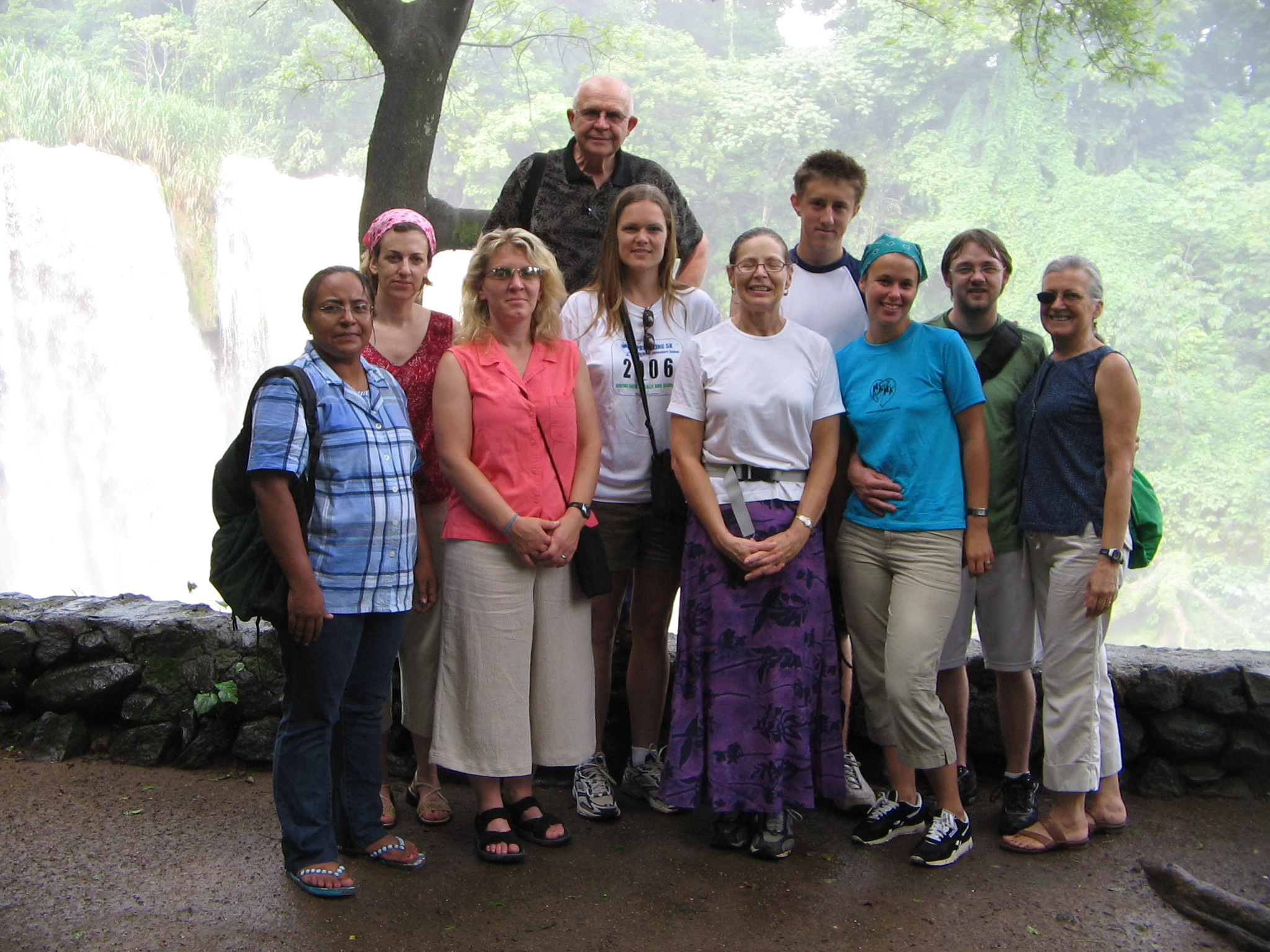
Early this year, my 17-year-old son, Patrick, decided that he wanted to go on a service project to San Pedro Sula, Honduras. I remember how excited he was, telling me he would help build a daycare center in Honduras’ second largest city. I was less than enamored by the prospect, but admired his sense of service and certainly didn’t want to discourage his humanitarian efforts. My husband, Ken, and I waited a few weeks to see if the idea would be fleeting, but whenever we mentioned it, Patrick would confidently say, “Yea, I’m going.” Finally, we stopped making plans for our trip out West and started to think about the realities of his decision. Would it be okay for him to go alone with the other MAMA team members from our church? And what if he got sick, as many of our church’s team members had on earlier service trips? Would others take care of him? And how would we pay for the airfare and expenses of such a trip? We told Patrick that if he was really serious about going, he would need to draft a letter asking family and friends for financial support for his endeavor. And he did.

Then a funny thing happened. Before I put too much thought into the decision (or the Spirit’s nudging, if you prefer), I found myself volunteering to accompany Patrick on the week-long service trip to Honduras. So, on July 15 of this year, Patrick and I flew to San Pedro Sula with eight other members of Ambler Mennonite Church. We struggled to remember the proper conjugation of Spanish verbs that teachers had drilled into us. We ate gourmet food, with every meal feeling like a savory feast prepared by knowledgeable Spanish cooks. We also experienced the polluted air, the energetic street vendors, and the vagabond boys of San Pedro Sula. Each morning we walked to the MAMA center, a few blocks from our hotel, to board a van for construction work and distribution of de-worming medicine in the village of El Progresso, but along the way we had to pass young boys, aged 10-to-18, living on the crowded streets, hoping against hope of providing an income for their families living in the village. It was a hard dose of reality for the 8 o’clock hour.

When we arrived in El Progresso, there was more reality. The school had not been started yet, and we needed to dig out the foundation walls before we could begin. This was the first day. On the second day, we learned what cement mixing is like in El Progresso. It meant using the street to mix 14 wheelbarrow loads of rocky sand with 4 bags of cement mix. Then we began the arduous process of hollowing out the center for water, filling it by bucketfuls from a neighbor’s cistern, and walking around the circle, gradually making the walls of the fortress higher.

At times the walls would spring a leak and then there would be a mad dash to blend the water and sand quickly. But on a good day, we gradually poured water from the center concave down the sides, till it all became a concrete mixture. By buckets this mixture was taken to the building site and poured by hand into the dug out dirt walls. Little by little we saw the foundation of the escuela emerge, till on the last day we put down the first two rows of cement blocks on the firm concrete foundation. It didn’t seem like we had accomplished much, but the community people were excited by the future prospects, and were so grateful for our efforts.

I’m still processing this trip to Honduras, but I know for sure that it was worthwhile—perhaps more for me than for the people of El Progresso. An extra benefit was watching my son interact with the Honduran kids, playing soccer at noontime when all of us were tired, and then later taking a leadership role among our team members. I had to wonder when he grew up and turned into such a terrific guy. It’s strange to see your son as a fellow team member with wisdom that you never noticed before. I felt like our roles were suddenly reversed, and he had more to teach me than I could ever teach him. That must have been the theme for the trip because I felt the same way about the Honduran people. Their graciousness and generosity, despite their lack of running water and adequate medical care, put all my “service efforts” to shame. So, I say thank you to the people of Honduras and the MAMA team in San Pedro Sula for teaching my son and I the true meaning of service and community. — BBM

Summer Road Trips

Summer Road Trips
Written Summer of 2007

Summer traveling brings memories of sitting in the back of our white Ford Torino, looking out between Mom and Dad’s head at the new and interesting sites.  My dad usually wore his heavy, dark-framed sun glasses with the pointed corners.  He always had a special lilt to his voice when we were traveling, like we were exploring new frontiers together.  He could even get more excited than us as children. When he took us up in an airplane for the first time, he was the only one shouting, “Beverly, we’re going to fly high above the clouds!”  My mom always had a voice to assuage any fears, assuring and gentle.  She often had a bag of tricks and treats on road trips for those times when I might get bored.  Daddy concentrated on driving while my mom played alphabet game and if all else failed, she brought out “celery candy,” which was celery cut in pieces rather than stalks.

Even now when I remember those times, I’m filled with an incredible feeling of security. All was well when we were on the road.  We left our troubles far behind and experienced new domains, talking and laughing raucously till it made our stomachs hurt.

Good summer time memories… that I still carry with me even though my dad is no longer around.  It’s fun to reminisce about the golden days of my childhood, but I can’t go back to those magical days any more than you can. Yet I believe God is patiently waiting for us, loving us, ready to laugh with us, ready to fill us with that same youthful wonder and anticipation. He not only loves us but is excited about all that we do and participate in. I can only imagine how wonderful heaven will be—like one unending road trip.

Iowa Roots Run Deep

Iowa Roots Run Deep
Written Summer of 2010

As another one of my sons prepares to leave the nest, I again grow weepy about his life so far and whether we taught him the things that we should have.   If I reflect back on Jordan’s life, I remember a delightful, funny, engaging toddler with an attentive smile for everyone.   He was never quick to talk, but when he did, his words carried weight.

Jordan most closely resembles my husband’s father in appearance and in demeanor.  They both have a slender build with a short stature; both slow to speak but full of wit.  They’re deep thinkers and rarely take offense. And just like Grandpa, Jordan loves golf and a good debate.

But some of the likenesses end there since Jordan’s grandfather grew up in Kokomo, Indiana as a part of the Old Order Amish church.  Since Grandpa was the oldest son, he had a lot of responsibility as the oldest to keep his brothers in line and do his share of the farm work. He enjoyed school but had to quit school after 8th grade to help out on the farm.  When Grandpa was 12, his family moved to Kalona, Iowa and a few years later, left the Amish church for the Conservative Mennonite Conference.

Jordan, on the other hand, grew up in Harleysville, Pennsylvania, far from the Midwestern corn fields. He went to a Mennonite church all of his life, but rules and regulations were probably not stressed as much as in the Amish church.  Jordan is the middle child and grew up akin to compromise and smoothing out differences.  He thrived in school, although perhaps not as motivated as he might have liked.

When Grandpa died last year, he left a legacy of honesty and integrity, frugalness and loyalty.  Jordan and Grandpa grew up so differently and in two different parts of the country, yet I’ve learned that character comes from within and it seems as if it can be born into a person.  Jordan loves the Midwest and feels most at home in the open countryside, golfing the quiet holes of Kalona, Iowa.  And just like his grandpa, he is frugal to a fault, never wanting to buy new clothes even when it’s obvious he needs them.  He is someone that does not spread gossip and can be entrusted with secrets aplenty.  These are things that I doubt I taught him, but that he was blessed with.  Best wishes, Jordan…may you make your grandpa proud.  -BBM

Daddy in the Fall

Fall’s Marvelous Craftsmanship
Written Fall of 2006

My dad loved the fall. Somehow, no matter how old I get, when the air starts smelling of burnt leaves and evergreens, I can’t help but remember my dad. I see my dad in gleeful anticipation of the upcoming deer hunt, enjoying every moment of meticulous preparation and hopeful expectation. And I remember Saturday mornings when he allowed me to experience the beauty of the hunt.

Since I was the youngest and the only child at home by age 12, I sometimes felt like my parents played tug-of-war with my time on a Saturday morning. Mom wanted me to dust and vacuum the living room and dining room, while Daddy needed me as a hunting companion, stomping through the fields to chase out pheasants and walking around the perimeter of the woods to rustle up inquisitive squirrels. On the days that I actually did accompany my dad, I remember the crispness of the air, how hard it was to keep up with my dad’s long stride, and above all, the quiet and peace of the woods. Being in the woods with Daddy was all about quiet expectation. Although a very talkative young girl, I quickly learned that Daddy expected complete silence and unless he specified otherwise, no movement whatsoever. But I began to find comfort and encouragement in the quiet, tranquil setting of the forest, listening to the voice of nature, the voice of an amazing Creator. And He faithfully spoke words of calm and steadfastness as the colorful leaves blew in the breeze, the honking geese flew overhead, and the bright sun danced with the shade.

I still stand in awe of the beauty of fall, remembering my dad and his innate ability to show me what an extraordinary world we live in.

Benner women

Honoring the Living
Written Spring 2009

I’ve always been fascinated with graveyards.  When I was young I spent a lot of my spare time in the Franconia Mennonite Church graveyard.  From the time I was 6, I lived on the nearby Halteman Road, so my neighbor Lori and I would often ride bike to “the church,” drink from the cold, satisfying water at the hand pump, and then go play in the back portion of the property.  We first sat in the enclosed basement entrance on the cement and played clapping games like “When Billy was one, he learned to suck his thumb” and then later we walked around the tombstones, looking at the old brown ones with illegible letters  and the newer ones with pictures of young children.

But recently, I realized at a gathering of my aunts and cousins that death is something to be honored while we’re still alive.  My cousins Mary and Lois began our time with an explanation of why we were gathered together –in honor of their mother and our aunt, Edna Styer.  It had begun as a belated birthday celebration, but as Edna made decisions about her health, it also had become a time to pay tribute to Edna’s life among us. As we ate soup and salads, my aunts, Dorothy, Irene, and Edna entertained us with stories of life at 240 Chestnut Street with Grammy and Grandpop Benner.  We discussed recipes and traditions but also past failures were mentioned and even the Rapture.  We sang songs that were Edna’s favorites.  While I listened to my aunts’ strong alto voices, I remembered Lois’ words about the funerals of Uncle Merrill, Uncle Marvin, and Aunt Kathryn that made her realize how nice it would be for the person to hear their tributes before they died.  So we took some time to tell Edna how much she had blessed our lives…

In the memories shared, we celebrated our lives together and our heritage as Benner women.  Lois even called us the “Sisterhood of the Benner women.” Of course we as cousins were sad at times to think we might lose some of the sisterhood charter members, our aunts, but we chose to dispel the fears with prayers and words of encouragement –a hope for the future. Graveyards will probably always hold their fascination, but I’ve been blessed with a new way to honor my predecessors. –BBM

A Summer to Remember

Loss and Laughter, a Summer to Remember
Written Fall 2009

When I was eleven my dad lost his job.  He had been working for Teleflex in Colmar for many years and was suddenly laid off in the spring of 1972 during a cutback in the labor force.  It was the summer of Hurricane Agnes, the Munich Olympics, and my sister going to Goshen College’s Study Service Team (SST) in Germany. 

Daddy was resourceful and found a job at Haeberly Orchard along with my brother, Steve, picking produce in season, mainly cantaloupes and watermelons.  Since my mom worked at a terry mill in Souderton and I was too young to be left alone at home, my dad and brother took me along and I learned to know the youngest Haeberly girl. She was quite an adventuresome individual who even had a pet raccoon.  We usually went for a bike ride to a nearby school playground and she entertained me with her stories of boyfriends and other antics.  Then we came back to her home, watched a little TV and visited with her cats, dogs and raccoon.  I think we both were so bored by the dog days of summer that we didn’t mind spending time with a complete stranger.

Steve and Daddy worked till noon and then we went home for lunch.  Daddy did his usual check in the garden for what he called our “daily manna.”  Daddy found great pleasure in our zucchini plants that had once again provided us with a meal.  Daddy used a little bit of butter, chopped onions, and the zucchini to mix up a tasty noon meal.  To break the monotony, sometimes he added a few eggs.  That was our lunch day after day.  It was the only time I remember my dad cooking and it’s been an image that has stayed with me.

Daddy had a way of making us kids feel like we were lucky to get any food at all and that we didn’t have enough money to pinch two pennies together.  “Things are tight this summer,” he’d say, “we’re going to have to learn to live on less.”  Now sometimes Daddy said things like this even when he did have a job, but there was something in his calm determination that summer that had a powerful effect on us.  We really felt the uncertainty of the situation, of waiting for our lunch from someone who had never cooked before and his excitement on finding yet another zucchini.  It was the unexpected goodness of God during an unsteady future. 

My sister Linda planned to go back to college at Goshen in the fall.  When my dad filled out the financial aid forms that summer, he looked at the space provided for his occupation, and wrote “migrant worker.”   He didn’t know what to call the work he and Steve had done that summer to provide for the family. My sister did receive more financial aid that year and as a family we laughed about my dad’s new found title. To be honest, even though I’m sure my dad felt totally deflated by life, his sense of humor carried us through that time.

On one night we laughed so hard that we even shook our Ford Torino with our spasms of laughter.  We were at the Neshaminy service plaza on the PA turnpike meeting a bus for my sister Linda to take to the NY airport and then on to Germany for SST. The bus was very late, in fact 3–4 hours late, because it had broken down and the director had to get another bus in order to make the connecting flights.  It could have been a very unpleasant experience, but for some reason we laughed our way through it. Daddy was in rare form that night, talking in a dutchified voice and recalling silly family stories …and I don’t remember ever laughing so hard, before or since. It was a summer filled with many pleasant experiences, despite my dad being out of work, and one that shaped my values and surrounded them with humor. -BBM

For my Heebner cousins

Visiting the Farmlands of Danville
Written Summer 2009

I went to my sister Rhoda’s house yesterday to visit with my cousins, Dot and Dorcas.  Their father had recently passed away and our family had gone to his funeral. As we sat and talked that day, the memories of our childhood came flooding back.

Their father was my mom’s brother from Lansdale, but in the 1950s, he had taken his young family west to farm where the open space was more plentiful and the possibilities seemed endless. That frontier spirit and hard work ethic was intriguing to us. In our family there was always excitement around the phrase, “Let’s go visit Junie’s (short for Albert Junior).”  We picked up on our parent’s admiration of this family that had left the comforts of immediate family to make a go of it in an area rich with fertile soil and potential.  It was the closest our family came to Laura Ingalls Wilder and we relished it. 

Maybe it was the trip, the excitement of getting away for a day, or perhaps it was the tone of voice my dad used when he looked at Junie and Kathryn’s massive farm and the latest milking equipment.  Mom loved seeing her brother again, sharing the familiar glimpses of their former home life on Snyder Road, a farm life that provided for all of their needs even during the Great Depression and where they walked a mile to school each morning.  Going to see Junie was like going back in time for her and glimpsing a former way of life, filled with early morning milkings and late night egg sorting, but also of berry picking in the woods and the best tasting canned pork chops.

So, we went to Junie’s for the day and Uncle Junie and Aunt Kathryn were always gracious hosts.  We first got a tour of the barn and the milking operation and then the new machinery.  I sometimes went along on the tour to catch a glimpse of the reason why my dad had that impressed tone in his voice. My dad encouraged us to see everything, “Come along, Beverly, you want to see this!” When I tired of this tour, I went in the house to find the cousin that was closest to my age, Dottie Lou.  We usually got out the Barbies and I loved seeing all of her latest Barbie clothes.  I could hear from the other room, my sister Linda laughing with another Heebner cousin, Debbie.  They usually started their time together with a laughing spell—that was their greeting for each other, contagious laughter and giggles. If my brothers were along, they stayed mainly outside among the barn with our cousins, Dean and David, admiring their life on the farm. Soon they came in for dinner and it was usually a big spread at a long table, full of scrumptious mashed potatoes, gravy, beef or chicken, fresh and cooked vegetables, jello salad, and whoopee pies for dessert. 

It was in all of us that when things got rough, we escaped to the wholesome life of Danville where we felt rejuvenated by the open space and cleaner air.  Apparently, my brother, Steve, even thought he could ride his tricycle up to Junie’s one day when things got tough.  We lived on County Line Road in Souderton at the time, so a trip to Danville would have taken quite awhile, especially by tricycle. My mom tried to discourage the trip by telling him, he “may not make it.” But Steve replied with a confident, “Oh, I’ll pedal real fast!” I don’t think he got much farther than the end of the driveway, but he certainly wanted to glimpse the comfort of the farm life on that day. Many thanks to the Heebner family in Danville for leaving us with such a rich farm heritage.                                  -BBM

Welcome to my writer’s blog

April 2, 2012- After returning from a weekend writer’s conference at Eastern Mennonite University,  I’ve decided  to take the plunge and start a blog. I’m on a writing journey to write a memoir, but I think I’ll start with using some pieces I’ve already published in a local newsletter, New Horizons.  This first one is about my mom. 

Having a 1960’s Career Mom
Written Fall 2011

My mom took on a part-time job when I was eight years old.  At the time, I disliked it very much, mostly because I was afraid of getting sick at school and there being no one able to pick me up.  I had to wait in the principal’s office quite a few times in my elementary years, which was embarrassing because it seemed like everyone else’s mom was able to drop things off quickly. Worse yet, during the “hot lunch” program of the winter months at Penn View Christian School when mothers brought lunches, I wished my mom had the flexibility in her schedule to bring a meal like everyone else’s mom.  I was keenly aware that I was different than most of my friends…their moms of course didn’t work outside the home.  In the summers, if my brother Steve was not available, it meant a note greeting me on the kitchen counter with a chore that needed to be accomplished and a time that my mom would be home again.

But now that I’m older I realize that my mom showed me at a young age that women are capable.  Through her example of getting a job outside the home, she showed me that women have intelligence and a skill set that enables them to not just be dependent on others.  She didn’t always think her feelings were taken into consideration in her close relationships, but she showed me that regardless of this, women could earn a living, balance a check book, and provide for their family.  She didn’t let her inexperience or self-defeating thoughts keep her down. 

Through my mom’s example, I began to see how a woman’s spirit could be challenged but not extinguished.  She showed me in a time when “female submission” was the lay of the land that a marriage could include open communication, disagreement, and compromise.  Many of these attributes, mom did not strive to teach me, but I see now that her unflappable determination as a woman and as a person with a right to be heard, made me the woman I am today. –BBM