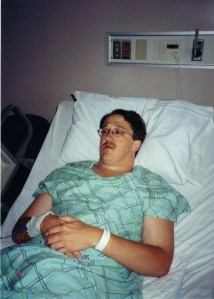
Daddy


Written July of 2003

We gathered together
not knowing this would be your last day
We sang songs heavenward
not realizing you were leaving us
But God saw fit to take you on a sultry
        Sunday morning in July
He counted the hairs on your head and
        knew in his merciful wisdom
        this was your time to go
Time to be released of a tired body that refused to receive air
Time to be released from financial responsibilities and obligations
Time to be released from earthly cares and concerns
And taken to brighter vistas
        to clearer, cleaner air that breathes easily
        to higher, more intricate mountain trails
        and to larger and more plentiful game

Good-bye, Daddy
You slipped away quietly, easily
       on a sultry day in July
but left us with your undying legacy
        your pride and determination
        your peace and nonresistance
        your boisterous laugh
        and unquenchable love of life
May your eternal life be just as richly blessed
May you enjoy your heavenly home
Well done, thou good and faithful servant

Ken’s Illness

Written Spring of 2009

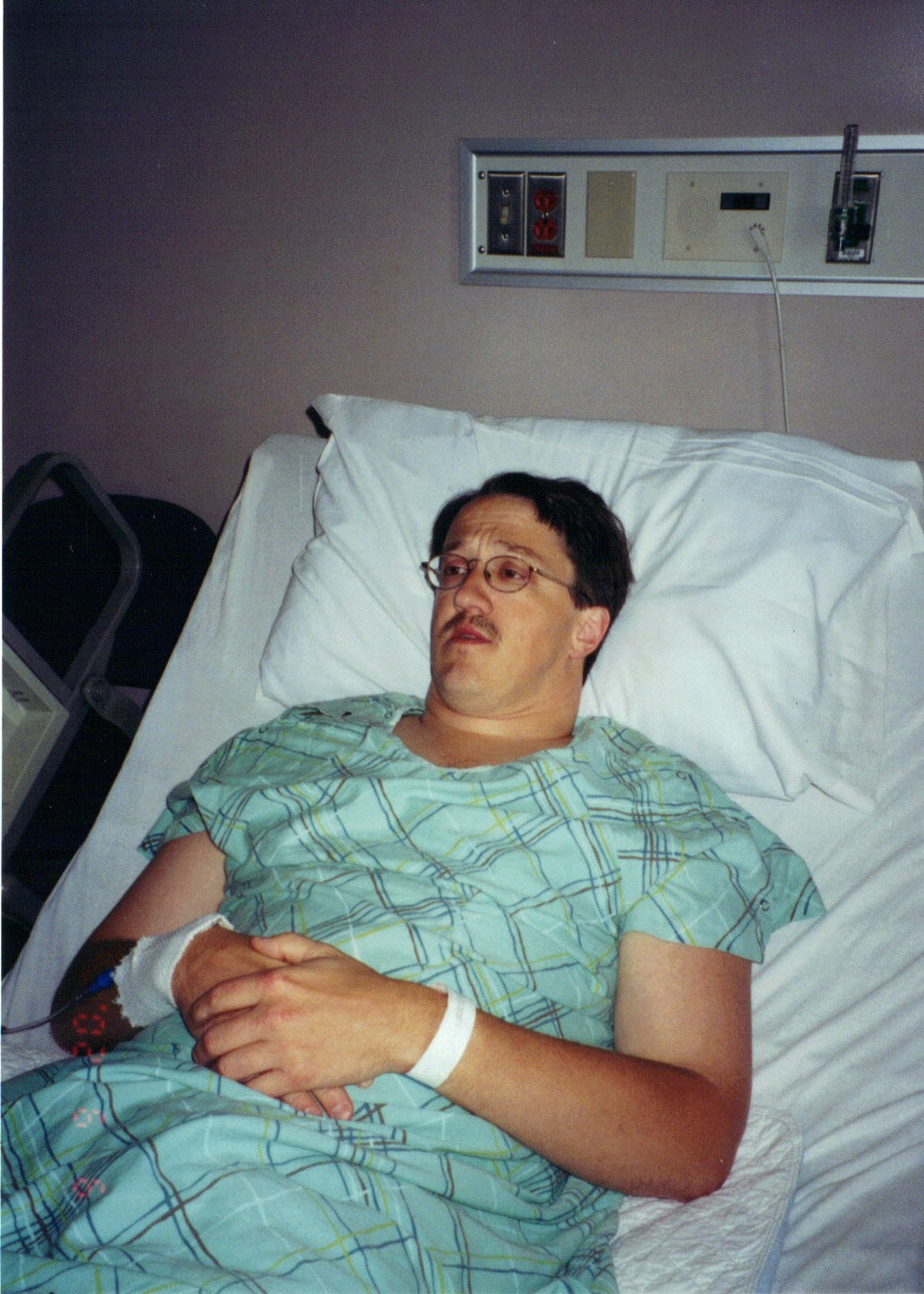
In 2002, I was sitting in the oncology department at Grand View Hospital crying.  I was crying because my husband had suddenly been asked to go to the hospital after visiting our family doctor.  It was a scary trip to the hospital discussing what ifs but it was even scarier hearing an oncology specialist say that he believed Ken had Non-Hodgkin’s lymphoma, a form of cancer that was, according to the doctor, curable.  I was in shock as I called my friend to alert the church prayer chain, I was in shock as I watched them wheel him out on a stretcher for tests, and I was in shock as I made my way to the cafeteria for a bite to eat.  That was one of the loneliest, saddest meals I have ever eaten.  I listened to the hub-bub all around me, the friendly chatter among nurses and among doctors and surgeons and in the middle of them I sat crying.  No one seemed to notice and if they did I looked down and tried to act unobtrusive. 

It was the beginning of June when the world had come alive with spring and the heat of summer was fast approaching.  My kids were in school yet, even Vanessa the youngest was in an all day kindergarten program.  How could I tell them their daddy was in the hospital?   

Thankfully, within a few days Ken’s parents arrived and after we got the kids off to school, we traveled together up to the hospital.  Then I had to hear their fears as well.  On the ride up, Ken’s mom admitted that a lot of his symptoms sounded like her dad (she whispered under her breath).  So I knew that was bad news and then asked if he was the one that had died of a brain tumor. She shook her head.  So many fears running rampant through our heads.  Ken’s dad just calmly sat in the back of the car, motionless, wordless. 

We visited with Ken but had to hold back our tears.  It was so hard to see him at the young age of 41 being captured by this mysterious illness.  I needed help and I knew it, so at lunch I suggested to Ken’s dad that we try to make Ken laugh somehow on our visits.  I told him I could tell Ken was picking up on our tension and that I knew we weren’t being very good company, but I needed help to laugh.  Well, Ken’s dad rose to the occasion and managed to lighten up the heaviness of that hospital room.  We laughed about Ken’s old little league experiences, seeing his old coach, and the well-wishes that were sent from his hometown in Kalona, Iowa. 

Soon Ken’s parents were gone and by that evening they had released Ken from the hospital with heavy doses of steroids and methotrexate.  The disease specialist from GV had visited him and felt like he had classic signs of dermatomyositis, a rare autoimmune disease that attacks a person’s muscles and skin. We felt relieved but we did not yet understand his prognosis.  It was going to be a long road to recovery. 

When Ken came home, he tried to do a few of his regular activities and before we knew it, he was back in the hospital again because he couldn’t swallow.  This time we went down to University of Pennsylvania and he was tested and probed.  He stayed there for another week and was given pureed foods that made him gag.  But the doctors were inches away from putting in a stomach tube so that he could take in nutrients.  He had failed the initial test in the Emergency Room when they gave him a drink of water and it came out his nose. His muscles looked fine, no evidence of damage, but they were too weak to make many of his organs function properly. 

Our two youngest children had gone with their grandparents back to Iowa, so we had only our oldest son, Patrick around at that time.  I remember on one occasion we made the trek down to Philadelphia on a Sunday and at about supper time, I went over to the adjoining McDonald’s to get food for Patrick.  He was 13 years old and found it difficult to sit still, so this occupied him.  But the smell of the McDonald’s french fries was almost more than Ken could bear when all they delivered to him were different colors of ugly, nondescript food.  He remembers this as one of his lowest times, smelling the food and not being able to eat it.  (Of course I may have sneaked him a few French fries.)  Soon Ken was released from the hospital and it was the three of us at home, watching movies late into the night and trying to see this undisclosed free time as a gift rather than a punishment.

He couldn’t even swallow his saliva and at night I would awaken to hear choking sounds.  I was to make sure he didn’t asphyxiate, or get any liquids in his lungs and the first sign would be a fever.  So I was on alert.  It was at times like these that I lay awake and cried out to God, setting my hand lightly on Ken’s shoulder and pleading with God for healing and a miracle.

But worse yet was seeing the doctor’s apprehension about the disease.  In the first few months when Ken continued to be in and out of the hospital, I remember a rheumatologist in Sellersville seeing Ken and then looking frantically through his medical books for answers.  When Ken walked out of the room,  the doctor repeated over and over while looking through his medical books, “He could die from this…he could die from this.” That was not reassuring to hear from a doctor and we soon switched to a rheumatologist connected with Abington Hospital who seemed more knowledgeable about Ken’s illness, and also more optimistic.  And Ken did improve.

Amazingly, day by day, Ken began improving and after 2 months was able to go back to work for short days. Sometimes it felt like 3 steps forward and 2 steps back, but gradually he gained more strength and endurance.  Sometimes the improvements were so slight, we didn’t even notice them.  But by the fall of 2007, when Ken caught himself partway through a fall, he acknowledged that yes, his illness had subsided. Of course, we often wonder if he will fall victim to dermatomyositis again, and if a person is ever completely healed of an autoimmune disease…

But for now, we live by faith, thankful for what has been restored.

This June marks the 10 year anniversary since his diagnosis in 2002. 

Mennonites Meet With President Roosevelt

Written Spring of 2010

I recently read again a book my father treasured, The Franconia Mennonites and War by Willard Hunsberger.  Many years before when I had looked at it, I had been sitting with my dad and he had pointed out men that I knew that had served at various Civilian Public Service (CPS) camps during WWII. Now, seven years after my dad’s death, I was looking at it again in a new way.  It was written in 1951 when the historical facts of World War II were still easily remembered and dedicated to John E. Lapp “who first conceived the idea of this volume.” Just as in 1951 “it is important that the rising generation be reminded of the faith of our fathers who were willing to leave home and country to maintain a good conscience.”

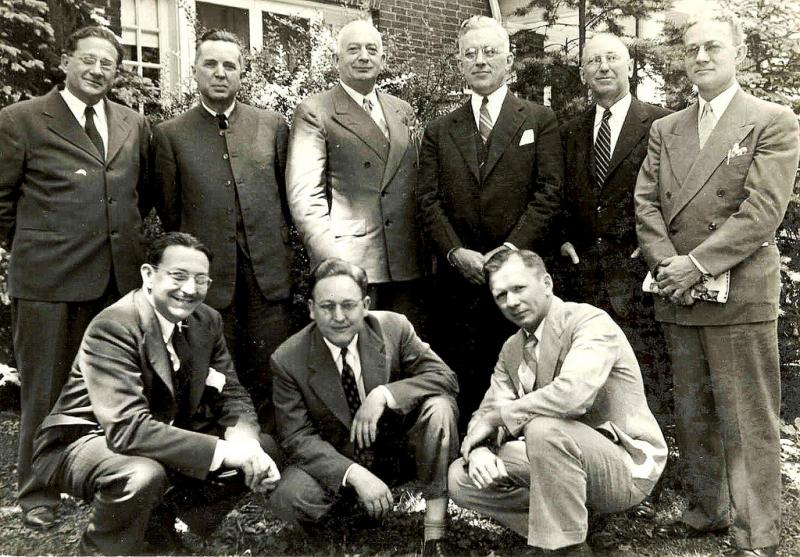
I didn’t realize the extent of the Mennonite church’s political involvement leading up to WW II, in 1937-1940. During that time, Mennonite church leaders wrote resolutions stating the Mennonite’s convictions regarding war and even met with President Roosevelt on more than one occasion.  Along with the Church of the Brethren and Society of Friends, the Mennonites continued to advocate a place of recognition for their young men that had a conscience against the “destruction of human life.” Orie Miller (pictured above on the National Service Board for Religious Objectors [NSBRO]), Harold S Bender, and E L. Harshbarger were just a few of the Mennonite leaders that worked tirelessly during this time period by traveling to Washington DC and presenting proposals that outlined the foreign relief, mental and medical health projects, and reforestry work that could be accomplished in CPS camps. But the actual 1940 presidential approval came only after the Mennonite Church agreed to finance the CPS camps and the men. 

In our Franconia Conference, a Peace Problems Committee of John E. Lapp, Jacob M. Moyer, and Jacob C. Clemens was formed.  “To aid in teaching nonresistance and to impress upon the people the urgency of the situation, the committee arranged for a Nonresistance Conference for September 3 and 4, 1939, which was held at Souderton Church.”  After President Roosevelt signed the Burke-Wadsworth Conscription Act,  making it law that all male residents between the ages of 21 and 35 register with their local draft board, this committee was on constant call, assisting registrants in filling out questionnaires, interviewing draft boards, and advising young men of draft age.  Many men from Franconia Conference benefited from the cordial relationship between the draft boards in Lansdale and Doylestown and the peace committee members, particularly John Lapp.  John helped many men navigate the unfamiliar world of Selective Service Law and draft board members that questioned their sincerity.  

These men had an immense support from their churches when they took that step of proclaiming their conscientious objection to war.

See http://civilianpublicservice.org/ for more information.

Spiritual Battles

Written Winter of 2003

Life seems so hard
behind each bend lies a torn curtain of pain
hope crumbles within
disappointment, renewed defeat emerges
Where do I turn for hope?
God feels too distant, caught behind
           critical spiritual leaders
           that only see my faults
Where is God? Does he still hear my cry,
harken his ear to my heartfelt prayers?

The disappointment starts as a kernel
         just a smidgeon
As night comes, it grows and peaks
        through the undergrowth
When all is quiet the sad loss of hope
        rests and cries in anguish
It enjoys the lack of light and revels
        in its lawlessness.
It beats its occupant, causing all
        body function to long for the light
But darkness continues,
        submerging the sane.

Life seems so hard
If only I could feel his holy presence,
       clasp his princely peace,
       and retain his loving embrace
Release me from mortal priests,
Fill me with the Divine.

To Be Mennonite

Written Spring of 2003
As found in my journal

They called you “yellow” and “coward”
despite your husband serving in Grottoes, Va,
far away from the growing child within you.

They didn’t understand your 
service to mankind as you
put out fires in Luray, Va, studied effects on quail,
ate sliders and grinders, and made
lifetime friends.

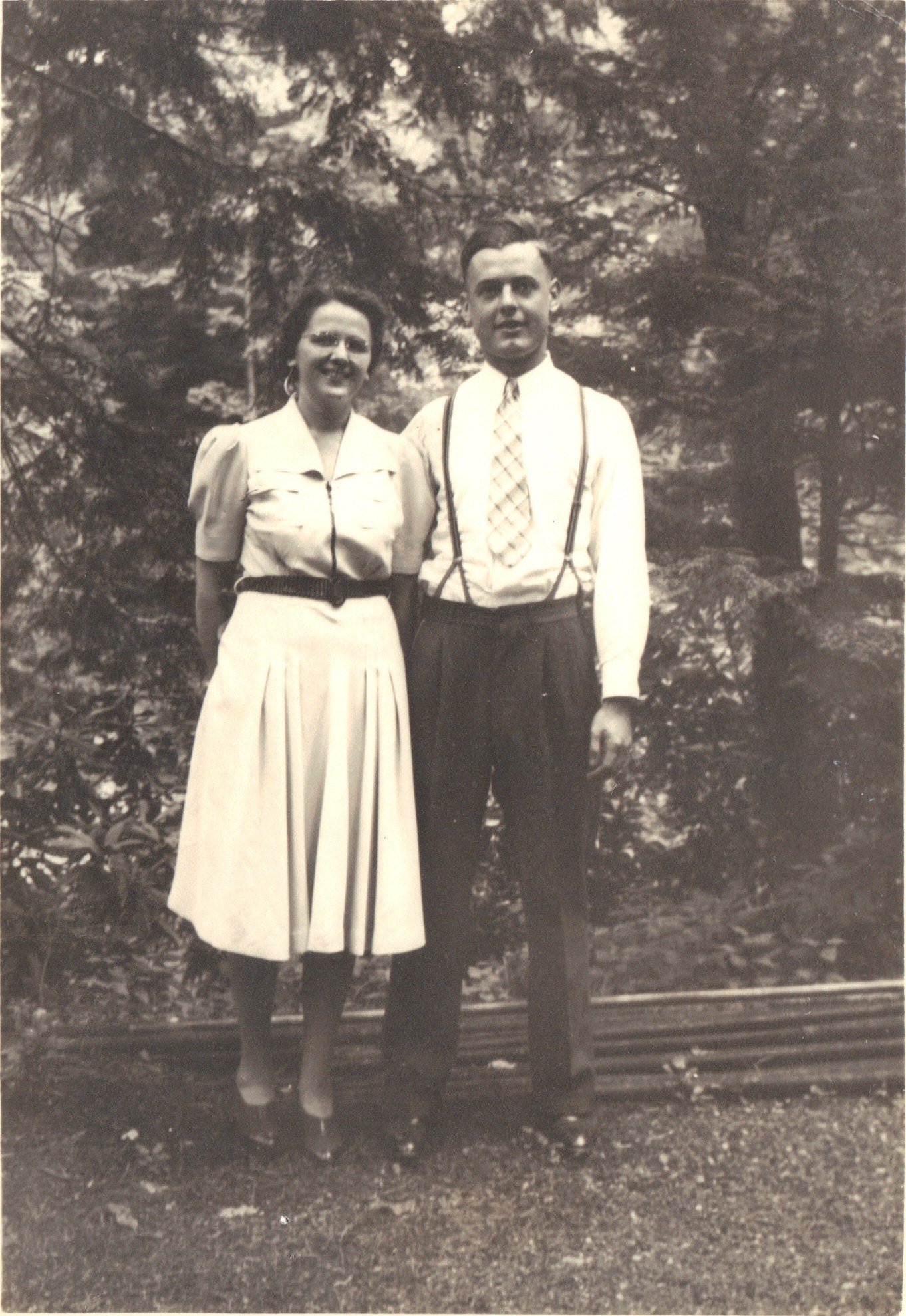
Mom and Dad—you represented
the Mennonite faith.
You began your life together
during hard times,
times of war and Civilian Public Service,
times of children born to parted parents, children
unacqainted with your difficult,
life-changing decisions.

At age 13, I cryingly explained to you
why I couldn’t wear a covering,
and at age 19,
why I questioned the words of Apostle Paul,
why I believed women should be allowed to speak in public.

And you patiently waited, waited for the
Mennonite in me to emerge, tested by 
the trials of life,
hoping I could withstand
the temptations of materialism and 
overzealous plaintiffs
to recover
peace
and
non-resistance.

Getting to Know Our Neighbors

Written Winter of 2012

Essie lived next door to us and was similar to Mrs. Dubose in To Kill a Mockingbird in that she faithfully yelled at my brothers when they played football on the open lot between our properties.  She seemed to be constantly grouchy yet she had her own special flair.  She was an elegantly slim woman in her 70’s who never made a public appearance without finely tailored clothes and bright red lipstick.  Her hair was plentiful and my dad claimed it was a wig, but regardless of its authenticity, it was dark black with her eyes lined to match.  She must have appeared very worldly to this little, protected Mennonite girl in the 1960s, but I admired her from afar. She was scary and more than intimidating to me. 

Essie had rumors circulated about her. She was a bit scandalous even in the 60’s and 70’s in that she was living with two men, one her husband that had been injured in the Battle of the Bulge whom she waited on hand and foot, and the other, a kind-hearted, broad-shouldered gentleman named George that provided constant companionship.  By any stretch of the imagination, Essie and George were people from a different walk of life, yet my parents were quick to assent to a visit when Essie inclined an offer.  On these visits Essie was most engaging and talked incessantly about her husband’s brave encounters in WWII. After the visit, my mom seemed bothered, not that my dad had taken the glass of wine offered, but that he had taken a second.  My mom invited them to our house for a meal on occasion also, but of course Essie was quick to return to her bed-ridden husband. 

She kept her house and property meticulous and we tried to measure up.  Steve and I always tried to tow the line, but inevitably, especially when our neighbor Jimmy was around, we saw the dreaded back door open, then the big black hair and the slender legs, then the tedious walk to where we were caught  motionless, followed by the unforgiving finger wag.  It could be relied upon every time we stepped out onto that open lot. It was not her land, but she patrolled it with a legalism that only she could muster.  She usually didn’t see me as I was sitting off to the side watching the neighborhood boys play.  I was glad she never saw me, but when I got a bit older and joined in on occasion, she usually added a lilt to her voice at the sight of a girl.

Robert Frost uses a quote in his “Mending Wall” poem of a neighbor that says “Good fences make good neighbors.”  I don’t abide by that.  I believe it’s good to get to know our neighbors as well as they allow us to and to be on hand when they are in need.  Sure they may be kind of grouchy and unapproachable at times, but I’ve found that generally, a plate of warm muffins on a Saturday morning has a way of removing the “grouchies.” I hope Frost would agree… I know Atticus Finch would. -BBM

To My Father-in-Law

Written Spring of 2009

Dad,
You slipped away so suddenly
We didn’t get a chance to say good-bye
We wanted to tell you how much we appreciated you
How much we loved your quiet and reassuring ways,
Your thoughtful analysis of current politics
Your ability to see through the issues of the church
Your anticipation and excitement on the golf course
And your listening ear and humble assurance of wisdom

You often were quiet and distant at our house when you came to visit
We didn’t always do or say things that pleased you, but we know, Dad,
Rest easy, we know—
We know that you loved and appreciated us, and wish you’d said it more.
We know that if it had been up to you, you would not have missed any of your grandchildren’s graduations.
We know that you didn’t want us to worry about money but to enjoy life,
We know that you wouldn’t want us to make a fuss over your death,
We know that you would want us to live a life of faithfulness to God by serving others.
We know that you would want us to remember your smile, your reassurance, your caring comfort, and above all, your undying love
So go and find rest with your heavenly father on the lushest, greenest golf course—you were a good and faithful servant.

Also published at http://www.cascadiapublishinghouse.com/dsm/winter10/millbe.htm

Forever Sins

Written Winter of 2012

Psalm 51: 1-17

This Scripture passage reminds me of a memory long ago when I was in elementary school and had to write 100 word or 300 word essays on why I shouldn’t talk in class.  Or perhaps write a line over and over again on the blackboard: I will not talk in class or I will not pass notes in class or I will not chew gum in class. The actual offense escapes me, but I remember more than once writing mindless sentences to absolve my sins.  They were the “penance” of how to rid you of your wrongdoing, but brought on immeasurable guilt and shame.

One of the memories that I’ve never been able to completely blot out happened a few days before my 8th grade graduation.  The principal at that time was watching our class when I happened to pass a note to a friend of mine.  The principal came back to where the note was being passed and quickly confiscated it.  She asked who had passed that note and I admitted to the offense. But that was not all.  When we walked out of class for lunch, the principal called me aside and said, “I will never be able to look at you the same way.”  That has stayed with me all my life.  I screwed up and someone would think of it every time she saw me … she would never forget it.  It would be a forever sin.

Thank goodness God isn’t like that.  With memories like that who wouldn’t want to soak in God’s presence, the one that is “generous in love—huge in mercy”?  He is a God of great compassion that can “blot out the stain of my sin.”

Matthew West sings “I’m the one with big mistakes, big regrets and bigger breaks than I’d ever care to confess,

But you’re the one who looks at me and sees what I was meant to be, more than just a beautiful mess

You are everything that I live for; everything that I can’t believe is happening, you’re standing right in front of me with arms wide open.”

God loves us even when we mess up, even when we feel it’s pointless to go on because we keep making mistakes. For me, I’d like to never say anything that makes others feel uncomfortable or upset.  But I keep doing it.  And I keep coming back to God for mercy….and forgiveness.

My First Date

Written Summer of 2009

When I was growing up, I really didn’t feel comfortable with any of my brothers and sisters.  I loved being with Mom and Daddy since they were who I knew the best.  I think my brothers and sisters all resented me for one reason or another.  I was often told that I was “spoiled” and “needed attention” or that I  “had to have my own way.”  My next oldest sibling, Steve, a quiet one, may have suffered, too, because of my presence.  We played games together and in the summer he had to watch over me, but we didn’t relate to each other that much.

My sister Linda lived in the same room and I admired her beauty and her sense of style. She went out on dates and seemed so desirable to men. Even though I knew I shouldn’t, I sometimes read her journals of her dating exploits for entertainment.  It was interesting reading and better than any romance novel.  But I also read Keep Yourself Pure by B. Charles Hostetler and wanted to remain pure for my husband and the Lord.  So, I had a lot of longings and desires as I sat hovering over my sister’s journals in the closet, yet had barely matured by my first date at 16. I didn’t want to go out with the guys who asked me, but when my brother told me I was “just chicken,” I decided to try dating.

First Date

I went out on a Saturday night with an upperclassman whom I also knew from church.  He wore big cowboy boots and was short, barely my height at 5”5.  He had a big pickup that was shined up real nice, but I wasn’t impressed.  In fact, I was experiencing a strong reaction….but not in his favor.

He picked me up around 7 and we went to a movie, I believe.  Then afterwards we went to the R & S diner.  I wasn’t hungry at all (not being accustomed to eating at night) but got something small. He was a regular at R& S and knew all the games, so we played pacman and other precursor electronic games.  It was hanging out time that went all too slowly for me.  I just wanted it to be over.  Well, when we finally got back home, I tried to do the right thing by asking him in.  He readily came in.  My parents were asleep, so we sat on the couch looking at pictures and talking and I was hoping he would leave soon and very afraid he would try to kiss me.

The one thing I clearly remember is that when he finally left, I went to my bedroom.  My mom got up and came over to my room to ask me how my first date went.  I told her that if that was dating, “I didn’t want any part of it.” It was just an eye-opening experience of how wrong it could feel when you went out with someone you weren’t remotely interested in.  I tried to steer clear of such actions in the future.

A Wayfarer

Written Spring of 2009

Growing up at Souderton Mennonite Church and Penn View Christian School, there was always someone in my class with the same first name as me.  So wherever we went I was Bev B and she was Bev D.  It’s kind of amazing since Beverly is not really that common a name.  It tells the story of a popular name during the early 1960s, I suppose. 

One of the most hurtful memories of mine about my name came from my years as a Wayfarer (similar to a Girl Scout) at church.  It was like a Christian Girl Scouts club.  We had to earn patches to put on our sash or bolero and the more patches we earned by reciting scripture the more diligent a Wayfarer we were.  It seemed like we had to recite a Wayfarer anthem of sorts, “Study to show thyself approved unto God, a workman that needeth not to be ashamed.” 

It was on one of these Wednesday night Wayfarer meetings that we as early teenagers were discussing names.  I was not one of the popular ones, so I mostly listened as others were talking.  Patricia and Bev D. were talking with others about the names they liked for girls.  (Aren’t girls always planning the names of their future kids?) Bev D. walked out of the classroom. Patricia mentioned a few names and then she said “Bev.”  I perked up and she looked directly at me and sneered, “I meant Bev D, not Bev B.”  Which is kind of ridiculous if you think about it, since they are the same name with only a different consonant on the end, but I never forgot that. I hated the way Bev B sounded, too, and thought that Bev D sounded so much nicer.  She was popular in almost every way.  A real nice person that was very athletic.  She had a multitude of friends; in fact, a whole group of people that wanted to be near her in gym class and when teams were picked.  Why is it that no matter how well you do academically in elementary school, relationships are decided and judged according to the picking of teams at recess?